The benefit of falling ill

illnessFalling ill is not always that bad, so long as you don’t catch anything nasty. Specially, if you are regularly working hard and are hardly ever with free time to do what you would otherwise do on an ideal day off. There is always “something” to keep you occupied and away from what you want to do.

So, today was that day for me. I’ve been feeling ill all throughout the day but it isn’t fever or anything. Seems some internal tiring or exhaustion, I cannot say.

Anyway, I spent most of the day working from home, since most of the work was unavoidable, but afterwards I did what I had wanted to do for years. I remained in bed and watched TV for almost 5 hours straight. And, I was watching my favorite channels like Nat Geo, Discovery and Animal Planet. Every hour passed by in a soothing manner, watching new and wonderful things these channels showed today, right from Air Crash Investigation to wildlife programs with snakes, lizards and crocs. It kept me relaxed for a very long time and I really enjoyed everything. I also wanted to read a bit but I knew that would stress me even more because I would need to sit in a proper posture, whereas watching TV was the laziest thing possible.

Now, it is close to midnight and it has just occurred to me that I could perhaps blog about it and encourage others to take a break for their own sake and do something calm and enjoyable even if it is as simple as reading a book or just watching TV. It really charges up your batteries and gives your mind a break from the everyday hassles of life.

I have switched off my TV now and would probably fall asleep next but I would like to know from you if you would also fancy the idea of falling ill once in a while to escape the grilling demands of everyday life and just relax. Do leave me your comments and tell me if you like this.

The Joys of Stargazing

Star Gazing

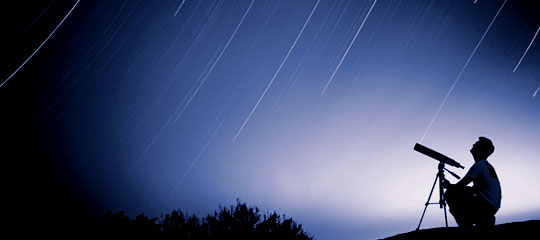
It was almost 4 AM on a chilly December night (or morning) in Delhi a few years back and I stood on the open terrace of my house gazing up at the night sky with my telescope. The sky was clear at last, there was no moon and so it was a good time to look for those otherwise hard-to-spot stars and star-clusters. To read the sky map, I had a torch double wrapped with red cellophane paper so as to prevent it from ruining my eyes’ acclimatization to the darkness.

Astronomy, or rather Amateur Astronomy, was a new hobby of mine, only a few months old. I had recently been reading as much as I could on the subject, joined the local Astronomy club, met and spoke to other passionate enthusiasts and even bought myself a 5-inch Newtonian reflector scope, which has become one of my most prized possessions. Reading on the subject and then spending time contemplating that knowledge gave me a new perspective.

Tonight, as I was gazing at the stars and contemplating the vastness of the universe beyond those skies, I started to get goosebumps. There are about a hundred billion stars in each of the hundred billion galaxies in our universe and I guess almost all of the stars will have their own solar systems – some big, some small. So that makes the number of planets in the universe so large that it is beyond comprehension of ordinary human brains. And yet, despite this vast number, we know of not a single other planet, except our own, to bear life.

“Who are we? We find that we live on an insignificant planet of a humdrum star lost in a galaxy tucked away in some forgotten corner of a universe in which there are far more galaxies than people.”

Of course, being the only known (to us) life bearing planet, makes our place quite special in the universe. And what makes us even more special is the fact that we are able to contemplate our existence and ask questions about our own origins and the origins of the universe and then seek answers to them using our own intelligence. We were formed out of the same starstuff that makes the rest of the Cosmos – the planets, stars, comets, asteroids as well as the galaxies billions of light years away from our own – and we have evolved to think and ask questions about ourselves.

“The nitrogen in our DNA, the calcium in our teeth, the iron in our blood, the carbon in our apple pies were made in the interiors of collapsing stars. We are made of starstuff.”

Yet, on the other hand we also know that the reason why we haven’t been able to find life elsewhere in the universe is not because it does not exist, but because we are not intelligent enough and capable enough of finding out. The vastness of the universe trumps our little brains. The gigantic interstellar distances dwarf by trillions and trillions of times any distances we have seen on our earth or even in our solar system. The cosmic clock runs on a scale that trumps the longest lifetimes of humans and make us insignificant. And so, as the contemplation went on and on in my head, I lost myself into an even longer train of thoughts and it was as if I was slowly being removed from the earth. And finally, I truly realized that my relation to the universe was far greater than I had ever imagined before. I had become one with the Cosmos, not in the usual religious way, but in a much deeper and meaningful way. Because as Carl Sagan said it so beautifully:

“The Cosmos is also within us. We are made of star-stuff. We are a way for the Cosmos to know itself.”

It is a unique perspective because it also makes me realize how precious our planet really is. We have our friends, family, idols and enemies all here on this planet. It is our home. Everybody we have ever known lives or lived here. Outside of it, there is just loneliness in the vast universe. That also makes everybody I know here that much more special. The apparent insignificance of my own existence is in itself the reason why I should continue to live because this is the only life I have and will ever have. And I am lucky to be here today. When I learn something about the universe, it is basically the universe learning about itself. When I look out at the Cosmos, the Cosmos looks back into me.

My thoughts are interrupted by a sudden strong cold breeze and I realize that I am now shivering. I hear a truck pass by somewhere in the distance but otherwise the night is very quiet. It is almost morning and the darkness is fading away. A bit like the darkness of my ignorance is fading away because of the knowledge of my own real self?

I am quite tired now so I gather my stuff and head back inside for bed, leaving my telescope behind as it continued to gaze endlessly at the cosmos beyond.

Remembrance of things past

Sometimes, I look back into my life to see how much of it was real and how much was made up. It is an important question and applies to everyone who ever lived. Not that I am a liar, but I admit that sometimes our sheer vulnerabilities make us believe in something that isn’t true. Sometimes we know that, and sometimes we don’t.

Make up a lie, and believe in it with all your heart and repeat it for a really long time, and you will see it becomes the truth. Children do this all the time. They imagine a world and then believe in it such that it becomes the truth for them. When you were a kid, don’t you remember taking credit for jokes that someone else said, or a story that someone else told? And over the years, at some point, didn’t that joke or story become truly yours? Or what about believing someone else’s ideas as your own?

Likewise, even as adults we are not so far behind. Every journey into the past is complicated by delusions, false memories, false naming of real events. Words that were never said, fights that never really happened, love that was only in my mind, plans that were never made, feelings that were never felt, letters that were never written and friends that never were. But repeat them often enough, and they become real. Our memories also deceive us.

“When I was younger I could remember anything, whether it happened or not; but my faculties are decaying now, and soon I shall be so I cannot remember any but the latter. It is sad to go to pieces like this, but we all have to do it.” ~ Mark Twain

Yes, every life has it. We all remember that which never happened. It is tough to admit it, but its true. Each life is like a book but with some untrue short stories. And many of these, we don’t even know are lies.

“Remembrance of things past is not necessarily the remembrance of things as they were.” ~ Marcel Proust

Reader’s Block

Is there such a thing as a Reader’s Block?

About 2 months back I wrote a blog on Writer’s Block that I was suffering from, and still do from time to time. And about 4 months back, I wrote another Blog called OverBooked, in which I described another situation similar to my Reader’s Block but with a peculiar difference.

In Overbooked, I spoke about how I felt spoilt for choices when it came to choosing what book to read simply because I have too many books and could not make up my mind on any one of them. But now, I write about my Reader’s Block, wherein I do want to start reading, but I want to know that with every page I turn I am gaining something important. I want to know that my life is much better, even by the tiniest bit, because of the last page I just read. I just don’t want to read for the pleasure of reading, for that pleasure I will inevitably find in whatever I read. I want to read because I would be miserable if I did not. And so, the book needs to be one which can remove that misery and fill the hole that is there in my heart.

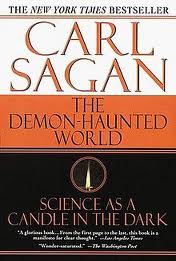
For instance, when I read “A Demon Haunted World” by Carl Sagan about a year ago, every line I read gave me sheer pleasure of the wonderful writing of Dr. Sagan and every page I turned made me feel my life was that much more enriched because of what I’ve read. Similarly, there have been books like “The God Delusion” by Richard Dawkins, “Cosmos” by Carl Sagan, Sherlock Holmes, “IACOCCA” by Lee Iacocca, “The Diary of a Young Girl” by Anne Frank and (oddly enough) “Confessions of a Conjuror” by Derren Brown, all of which have made me feel better about having read a book from which I am taking away something.

And, so I started reading “Relativity” by Albert Einstein this evening, hoping to understand the world much better and peep into the mind of the man who stunned the world with his genius. It is a good book and challenges your intelligence but it isn’t what I want, though I will still finish it very soon.

But now, I am stuck again, this time not for choice but for content. The book I read needs to give me something of intellectual value, where each page turned makes me happier than before. Something, that I should be proud of having read. A book that gives me a reason to be happy or a book that destroys my closely held prejudices. But most importantly, a book which upon opening makes me forget the world. It’s a tough choice because what I might see as an intriguing read might be boring to someone else. I keep remembering this quote I found on the internet:

Always read something that will make you look good if you die in the middle of it.  ~P.J. O’Rourke

So, please dear reader, help me out and suggest a book that you think I will open and then lose myself. Please leave your suggestions in the comments section.

Thanks for reading!

What can you not live without?

When one is faced with a dilemma, on choosing one of two possible and opposite options, how does one decide?

Do you look at what you can live with?

Or

Do you look at what you can’t live without?

These are two very different questions, though they may stir the same thoughts in the mind of the thinker.

For example, if you are a writer and not such a success at that, you would ask yourself what is more important:

Can you live with unsuccessful writing?

Or

Is it that you can’t live without writing at all?

Another example, you want to gain someone you love, but that will bring some issues along with them and so wouldn’t you ask yourselves:

Can you live with the person + issues?

Or

Is it that you can’t live without that person you love?

Which of these is more important? What you can live for or what you will die without?

Blinded by Astrology?

Looking up at the stars, I know quite well
That, for all they care, I can go to hell.

— W. H. Auden

Of late, I have been having conversations with people and who are ardent proponents of Astrology, as well as with my own inner self that just doesn’t agree with this, and it is with a heavy heart that I conclude that humanity will always be split between believers and non-believers. Though it may seem plainly unreasonable to non-believers like me why there are people who live their lives aligned to their horoscopes and star charts, it is still a sad reality that there isn’t much we can do about it. Except that we can take to fighting this social evil in a case to case basis and only when we are ourselves affected by it.

But even then, you sit with someone who seriously follows astrology and you will realize how difficult it is to talk to them. The first point they make is, “I know it works because I have seen it work. And ever since XYZ happened, I am a hundred percent sure that it works and I will never dare to ignore astrological predictions anymore.”

Try and counter this with a rational argument citing examples of how terribly wrong these predictions can be at most times, and you are cut-off in between by something like, “I understand you may not want to believe it but I can tell you that it really does work. Now, of course I cannot explain how it works, but you must take my word for it, as also consider the testimonials of countless others whose lives have been positively affected by recognizing this science. It is an ancient “vidya” (Hindi for body of knowledge) and there are only a few real masters of this vidya while all others are lesser practitioners and that is why you find some predictions that may turn out to be incorrect.”

Now, this is obscene. Can you imagine a science teacher teaching like this in a science classroom:

“Now, when I say that the sum of all interior angles of a triangle equals 180 degrees, you must trust me on this and take my word for it. I have studied mathematics in college and am far more educated than you are so you must trust me. I agree that your other maths teacher gave you proof yesterday that sum of all angles is 160 degrees, but very few people have more knowledge on this subject and so you must trust me.”

What if, at the end of each year at college, instead of having exams to test students’ knowledge, we could simply read their horoscopes to know how much they would score in each subject and then grade them accordingly? Wouldn’t it save a lot of time, effort and money on part of both the teachers and the students?

What if schools decide that instead of asking students what streams (like engineering, law, medical science, business, etc.) they wanted to specialize in, they simply read the horoscopes of each one and allot subjects accordingly? “Greg’s horoscope says doctor, Henry’s says Lawer, Patrick’s says he’s gonna have a short life so let’s just expel him.” Wouldn’t that be brilliant?

Why do we vote for governments every few years when we could easily just publish the horoscopes of every man in the country and then pick the best of those for the top job? Why don’t we let horoscopes decide which players are going to excel today and pick only them in the team?

Why hire judges and lawyers in courtrooms when the outcome can even be decided by the local astrologer by reading the horoscopes of the  aggrieved parties?

Let me tell you the answer to all these WHYs and the answer is that we don’t know anything for sure. We don’t know what is going to happen and that is the way the world is. It is depressing that we do not have satisfying answers to all our problems, we want to define why somethings happen while others don’t so that we can bring some sort of order to our lives.

We have no command over our futures and nobody knows anything for sure but being human means dreaming, aspiring, working hard, fighting the odds and if we take these elements out of our lives, then being human means nothing different from being just another animal.

In my conversations with believers, my point is never to convince them this astrology business is a fraud and hopeless. I know people, including me, have fear of the unknown and who am I to deny someone their right to feel better even if it means a little bit of superstition? And I also know that rational arguments will rarely convert a staunch believer. But what I always do say is that “You can never know for sure” and so when it comes to decisions of life and death, of someone’s happiness, dreams, aspirations of people that we care about, let us not be so cruel as to flaunt our arrogance of “knowing for sure” and forcing them to confirm to what a piece of paper with some boxes and numbers drawn on it says about them.

Let us be superstitious, but let us also draw a line between what is harmless superstition and what is harmful with life-altering and devastating consequences.

Because, if it is indeed true that everything that happens and is going to happen in this world is already written in some star charts, then doesn’t it make life, effort, love, hate, ambition, success, dreams and all human experiences pointless? Isn’t it demeaning to be told that all your dreams and efforts mean nothing just because your horoscope said something will not happen? And if the horoscope does fail, you dismiss the failure as a lack in completeness of knowledge of such a complex “science”?

Doesn’t it diminish the essence of being human whereas?

What do you think?

“There are two ways to view the stars: as they really are; and as we might wish them to be.” – Carl Sagan

My Attempts to Read That First Novel

During my school days, I remember, a lot of other kids used to pass time reading some books while travelling in the school bus or while bunking classes. At that time, I was not introduced to reading as a hobby and so obviously I found it a little mysterious how some of them could actually read books which were over a 100 pages thick. Don’t take me wrong, I did do a lot of reading of my own, but it was always comics and never any serious reading like novels. And it is also not that I don’t consider reading comics as requiring an equal zeal, but reading novels was something different for me. Something unattainable.

Finally, when I was in class 10, one of my uncles visited us and when he went back, he incidentally forgot his Jeffrey Archer novel called “A Matter of Honor.” This was the first novel ever to lie around in my home in my memory and a few weeks passed and it kept calling to me. Many times, I would pick it up, check out its pages and cover and then put it down again, not sure what would happened if I opened it, until a day arrived when I could just not resist anymore.

I cannot forget this book ever because of the number of time I tried to read it and failed. I clearly remember the first time I started reading it, I went on for 5-6 pages before putting it down. Why? Because I just couldn’t understand anything. Few days later, I tried again and almost reached the end of the first chapter. Still nothing. So I quit again. I think I tried a few more times and the only thing I remember even now from that first chapter was the name Romanov and I guess some terms related to Russia. I guess it was just too much and the information was too new for me to understand. Finally, one time I decided to read on after reaching the end of Chapter 1 onto Chapter 2. I really compelled my self to continue reading even if it did not make sense and see what happens. And as I read more and more I started to understand what was happening and it turned out that I was actually enjoying it a lot. It grew upon me with such pace that I could not sleep at nights because I was so engaged in it and it took me a few days to finish my reading. (Come on guys, it was my first book).

I think that book changed my life because it encouraged me to read more and more. Starting with other books of Archer and then going on to read Sydney Sheldon and others, reading quickly became a habit that I haven’t been able to give up even 13 years after that first novel. Today, not a days passes without me reading at least a few pages from one of the hundreds of books that I own and keep in my bedroom.

Now that I think about it, I was very fortunate that my uncle forgot that book at my home. And I feel it was really good that I did not give up on that book despite failing to so many times in my attempts to understand what reading was all about.

Today, reading is my life’s greatest passion, a sort of obsession, and I am happy that I got into it and it will always be something that I can never give up.

Banning and Burning Books

Thomas Jefferson, the founder of America, once quoted: “I am mortified to be told that, in the United States of America, the sale of a book can become a subject of inquiry, and of criminal inquiry too.”

Today, it is not uncommon to hear that a certain book has been banned in some countries across the world. Take, for instance, The Satanic Verses by Salman Rushdie. This book was first published in 1988 and is said to be inspired in part by the life of Muhammad. Though I haven’t read this book myself, I do consider this as an important example in the context of this topic.

Protests against Rushdie and his “The Satanic Verses”

“The Satanic Verses” has been banned since 1988 in Bangladesh, Egypt, Iran, India, Kenya, Kuwait, Liberia, Malaysia, Papua New Guinea, Pakistan and many other countries. Copies of the book were burnt across the world, amazingly by people who either never read it or did not know how to read. The reason for the ban, we were told, is that this Novel (its Fiction guys) is alleged to contain blasphemy. Notwithstanding the fact that this book went on to become a 1988 Booker Prize Finalist and won the 1988 Whitbread Award for novel of the year, the ban on this 24 year old book still prevails in many countries. Not only that, the outrage among some Muslims resulted in a Fatwa calling for Rushdie’s death issued by Ayatollah Ruhollah Khomeini, the Supreme Leader of Iran in 1989. To top it all, Rushdie, who should have been a national asset, was even forced to flee from his homeland and he now lives in exile in the UK.

Those who are in favour of banning this book claim that this violates their freedom of religion by being blasphemic, the opposite point of view simply states that works of literature and fiction should not be judged against blasphemy based on the interpretation of some sections of a religious group.

For those who might think that banning this book was no big deal, let us take a look at some of the other more surprising examples of books that have been banned in the past for some reason or the other:

  • The Rights of Man– by Thomas Paine, who is one of the founding fathers of America.
    This book was banned in UK.
  • Lolita – by Vladimir Nabokov
    The book is widely critically acclaimed and was ranked 4th on the Modern Library’s list of the 100 Best Novels of the 20th century.
    This book was banned in France, UK, Argentina New Zealand, South Africa.
  • Nineteen Eighty-Four: A Novel – by George Orwell
  • Animal Farm – by George Orwell
    This book was widely censored in US and UK for being critical of USSR. It is a political satire and one of my favourite reads.
  • The Da Vinci Code – by Dan Brown, and now a major Motion Picture
  • Alice in Wonderland – by Lewis Caroll. Surprised?
  • The BibleNow surprised?
    Censored in dozens of countries, both historically and in the current era. Currently, the Bible is banned or greatly restricted in a number of countries including North Korea and Eritrea. Sometimes, the ban is on distributing the Bible in certain languages or versions. In 1234, King James I of Aragon ordered the burning of Bibles in the vernacular.
  • … and so many more.

For a more comprehensive lists of banned books that might surprise you, visit:

http://www.spaciousplanet.com/world/new/the-21-most-surprising-banned-books

Now, the question one needs to ask is this: Who decides what is offensive? And who decides what others should be allowed to read and what not? For instance, I might find a certain book offensive but what right do I have to deny others access to it?

After all, it’s not that a book is ever offensive. What people, who frequently get offended, really fear is an idea. It’s always an idea that they are uncomfortable with. For instance, the book, “Uncle Toms Cabin – by Harriet Beecher Stowe” was banned in southern US for its anti-slavery content. Yes! You heard me right, its anti-slavery content.

Galileo’s Mistake?

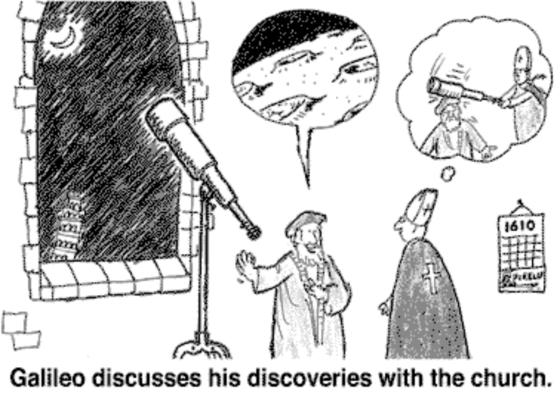
It is true of the history of our world that all great and revolutionary ideas are first met with resistance from the highest of quarters. It is only after they spread to the masses and people start to understand them that some sort of acceptance starts to come in. Take, for instance, the ideas of Galileo Galilei, the father of modern observational Astronomy, also considered widely as the father of science itself. Amongst his other accomplishments in the field of observational science, Galileo also championed the idea of heliocentrism – that the planets all revolve around the Sun and not around the Earth. This concept is, beyond any doubt, the universally accepted model of the Solar System and no one in their right mind would dare to challenge this idea except if they were insane. However, the same idea, led to Galileo’s being tried by the Roman Inquisition. He was found “vehemently suspect of heresy” due to his observations, was forced to recant his scientific findings to avoid being burnt at the stake and spent the rest of his life under house arrest. And all this, for observing the most basic of natural phenomenon.

It is to be noted that finally in 1992, Pope John Paul II formally acknowledged in a speech that the Roman Catholic Church had erred in condemning Galileo over 350 years ago for asserting that the earth revolves around the sun.

My point of giving this example is that in every age, most of the people of a society will have only a low intellectual capability and the ability to think for themselves. It is only due to the revolutionary ideas of some great thinkers and their perseverance against resistance by this multitude that societies are able to grow out of one dogma after another.

Imagine what would have happened if the heliocentric model of the Solar System was never allowed to be accepted. Would humanity have moved forward and made all its advances or moved backwards? What if the ideas of Independence and self-reliance continued to be crushed under the pretext of being offensive to the ruler? Would we have known the USA as it is today? Or the independent India as it is today? One of the most important contributors to the French Revolution was the same “The Rights of Man – by Thomas Paine” as mentioned in the list above.

Now, some people might argue that they do consider some literature to be offensive in a genuine sense. Definitely, it is possible that there might be some bad ideas. For instance, denying that Jupiter is just another world (planet), like the earth is, is a bad idea today. Slavery? Bad idea. Alchemy? Bad idea. But what we do need to note here is that none of these bad ideas were purged by banning books that talked about them, they were replaced by allowing the free flow of ideas that replaced these bad ideas. For instance, Alchemy was replaced by allowing Chemistry to be discussed and not simply by banning the thought of Alchemy itself.

Therefore, my point is that those who consider some ideas to be offensive or hurtful should endeavour to expose the fallacy of those ideas by writing about them through the same medium and presenting a strong case for their stand. If not, then nobody should hold people’s lives to ransom and demand that others’ ideas be forcefully suppressed. At the worst, if a book offends you, just don’t f****** read it.

“Books are like mirrors: if a fool looks in, you cannot expect a genius to look out.” ― J.K. Rowling

Next question that one must contemplate is: whether these bans actually make any difference anyway? In today’s information age, it is virtually impossible for governments also to stop anyone from gaining access to any idea, thought or book, whatever strategies they may try. It is just useless and therefore the civilized society should continue to allow free flow of ideas in order to remain truly free.

After all, there are millions of people like me who hate the idea of having even a single book banned. Yet, we do not take to the streets massacring hundreds or thousands, burning buildings and demanding the heads of those who did not allow us access to a book that we want to read in our own personal time. What we do is we talk about our opinions and blog about them because we know that our idea is simply better that their idea and that it will ultimately prevail.

Burning books has never been the answer to anything and can never be acceptable to a civilized society. Because at the end of the day books won’t always stay banned. They won’t always be burned. Ideas won’t always go to jail. In the long run of history, censorship and the inquisitor have always lost. The only sure weapon against bad ideas is good ideas. The source of better ideas is wisdom. The surest path to wisdom is a liberal education.

“The books that the world calls immoral are books that show the world its own shame.” – Oscar Wilde

The sooner we realize this, the better we become.


Notes:

List of Books banned books: http://en.wikipedia.org/wiki/List_of_books_banned_by_governments

The Voyagers

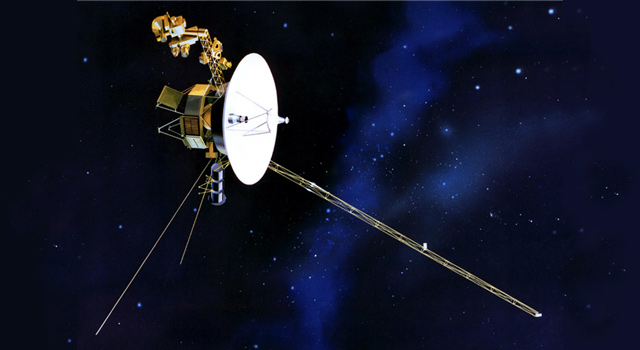
The Voyager Spacecraft

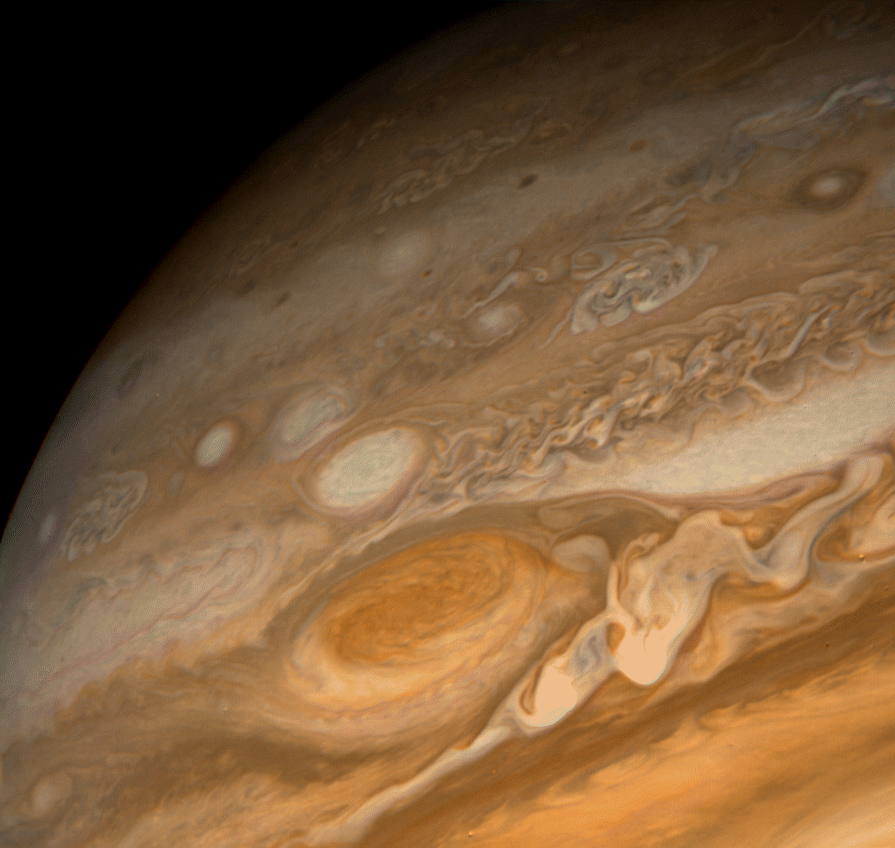
Jupiter’s Great Red Spot – Photographed by Voyager

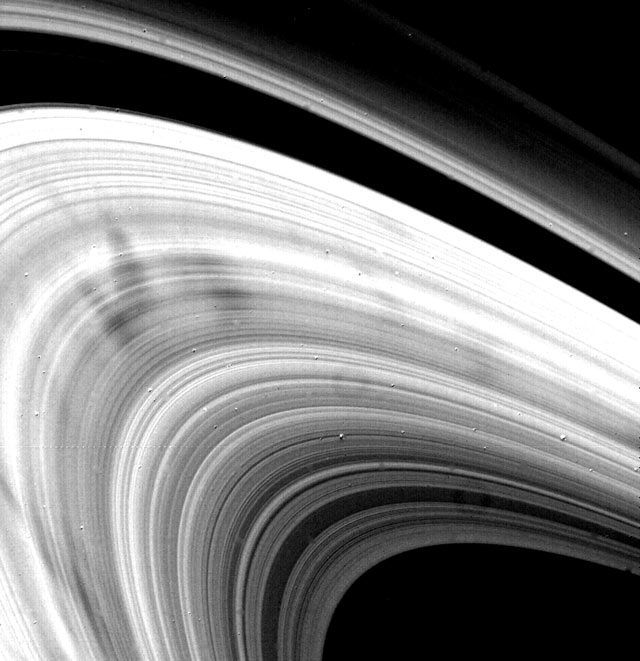
In 1977, NASA launched the twin Voyager 1 and 2 spacecrafts whose primary mission was the exploration of Jupiter and Saturn. After making a string of discoveries there — such as active volcanoes on Jupiter’s moon Io and intricacies of Saturn’s rings — the mission was extended. Voyager 2 went on to explore Uranus and Neptune, and is still the only spacecraft to have visited those outer planets.

Saturn rings with “spoke” features in B-ring. Aug. 22, 1981. 2.5 million miles.

Their extended mission is now called the Voyager Interstellar Mission (VIM). As of this mission, the Voyager spacecrafts, which have drifted to the edge of the Solar system beyond Pluto, will continue to explore the outermost edge of the Sun’s domain. And beyond.

The Voyagers are currently in the Heliosheath, – the outermost layer of the heliosphere where the solar wind is slowed by the pressure of interstellar gas. It is basically the zone beyond which, the Sun’s influence ends and we reach the interstellar space. And they are still sending scientific information about their surroundings back to Earth.

The Golden Record

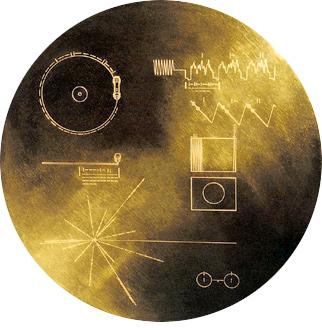
But that is not all that is wonderful about these crafts. NASA has also placed a very ambitious message aboard the Voyagers 1 and 2. Each craft contains a 12-inch gold-plated copper disc, called a phonograph. This disc contains sounds and images that are selected to portray the diversity of life on Earth. The contents of the record were selected for NASA by a committee chaired by the great astronomer and astronomy populariser, late Dr. Carl Sagan of Cornell University. They have included a variety of natural sounds like wind, thunder, birds, etc. along with musical selections from different cultures and eras and spoken greetings from Earth-people in 55 languages. And a lot more.

The extremely ambitious hope is that sometime in the future, some extraterrestrial beings might discover the Voyager and will look at it and discover the Golden Record. They might not understand the strange sounds that the record will make. We don’t know if those beings will even have the same sense of sounds as we do or will their “ears” be differently capable? Will they have vision like us or will that also be like something we cannot even imagine? We don’t know. And they will never be able to figure out where this came from, which edge of our galaxy, which direction, which planetary system around which of the billions of stars inhabiting the milkyway. None of this will ever be known to them. And we don’t even know if there ever will be a “them” to discover our message.

At the time of writing this blog, I checked NASA’s website (http://voyager.jpl.nasa.gov/where/index.html) and found that the Voyager 1 is currently 18.169 billion kms away from the Sun. When you think about it, the vastness of this distance trumps our brains. Can we imagine a distance of 18+ billion kms? It is unlike anything we have ever measured on earth of course. Yet, in the context of the size of the Milky Way itself, this distance is nothing but a fraction of a fraction of a small dot.

The Voyager spacecrafts are both beyond Pluto and they find themselves in empty space now. There is nothing there to see, except darkness. There is no upcoming planet, no moon and no source of light as well. The Voyagers will continue their slow and patient journey for the next thousands of years or maybe much more.

Eventually, the Voyagers will pass other stars. In about 40,000 years, Voyager 1 will drift within 1.6 light years (9.3 trillion miles) of AC+79 3888, a star in the constellation of Camelopardalis. In some 296,000 years, Voyager 2 will pass 4.3 light years (25 trillion miles) from Sirius, the brightest star in the sky. The Voyagers are destined—perhaps eternally—to wander the Milky Way.

Will we ever hear from the voyagers when they reach there? That’s not possible. Will humanity even exist after such a long time? Extremely improbable. But whether humans exist or not, and whether some other extraterrestrials even find and read our message or not, we have already communicated to the cosmos announcing that we existed and dared to look up at the sky. We looked at the distant stars and contemplated the vastness of the universe. We understood and are still trying to understand what we see when we look up at the night sky.

Thousands of years into the future, we may not exist but this message will exist and probably through this, we will continue to live in a poetic sense. I am sure that the majority of people on our planet don’t even know about the voyagers and what I have described above. Most of those who do might never understand the depth of this endeavour. But it is important that we do know and that is why I am even writing this.

Does this adventure of the voyagers make any difference to someone when they are going about their lives trying to make a living, maintaining relationships, planning for their future, worrying about daily stuff, etc.? Maybe not. But then, neither does any form of poetry. Still most people are greatly moved by poetry and this lonely and courageous journey of the voyagers is nothing less than poetic. We may not be able to travel such interstellar distances ourselves because we are humans and need food to survive and we do not even live for so long. But we have made something that will carry out this journey on our behalf.

Knowing that the universe is largely a lonely place with nothing for trillions of miles and no one to contact is a saddening thought. Knowing that our efforts, however grand we might think them to be, are really never going to be good enough when you contemplate the vastness of the universe is a very humbling thought. Yet, we should take great pride in the fact that we know our limitations very well but we do not fear failure.

As Carl Sagan has noted, “The spacecraft will be encountered and the record played only if there are advanced spacefaring civilizations in interstellar space. But the launching of this bottle into the cosmic ocean says something very hopeful about life on this planet.”

We may not have all the answers to all the mysteries of the universe but we do represent a thirst for knowledge that defines being human. And this thirst for knowledge, adventure, courage, hope and ambition for unravelling the mysteries of the universe will always be the symbol of being human. And having a common understanding of the grandness of the cosmos will only bring us all together. We will learn to care about the planet and our species because for over trillions and trillions of miles, we will not find another like us.

P.S: I am not a scientist or a science writer by any stretch of imagination, but what I do represent is my own thought and  understanding of the world. There certainly are better knowing people than me and I do not claim to be an authority on this subject and most of the factual data in my blog is sourced from NASA’s website: voyager.jpl.nasa.gov. What I have added are my personal feelings about this.