My Goodreads Reading Challenge for 2013

It has been a month into 2013 already but this year, I have set a target of reading at least 26 books in the Goodreads Reading Challenge 2013 and of hopefully surpassing this number by a good amount. It is Week 6 and I am about to finish my 3rd book of 2013 already:

127 Hours

127 Hours: Between a Rock and a Hard Place by Aron Ralston

Before this, I have already finished reading the following:

1. Into Thin Air: A Personal Account of the Mt. Everest Disaster by Jon Krakauer (Read)
2. Annapurna by Maurice Herzog (Read)

I know it looks like I am reading mostly mountaineering/adventure/survival books starting of 2013 but I have developed a real liking for this genre.

But if you thought I was stuck with still the same genre, here are also 3 more half-read books that I am still going to continue reading in parallel with my other book depending on my interest level, so it is not that I read only 1 book in 2 weeks:
 
3. The Fry Chronicles by Stephen Fry
4. The Satanic Verses by Salman Rushdie
5. The Motorcycle Diaries: Notes on a Latin American Journey by Ernesto “Che” Guevara
 
And, the next few books in my Reading List are:
 
6. Alive: Sixteen Men, Seventy-two Days, and Insurmountable Odds–the Classic Adventure of Survival in the Andes by Piers Paul Read
7. No Way Down: Life and Death on K2 by Graham Bowley
 
So, that takes care of 8 of my target of 26+ books in 2013. Any other recommendations?
 

The Quotable Mark Twain 2

marktwainquote

“But who prays for Satan? Who, in eighteen centuries, has had the common humanity to pray for the one sinner that needed it most?”

“All you need is ignorance and confidence and the success is sure.”

“There are lies, damned lies and statistics.”

“All generalizations are false, including this one.”

“Life would be infinitely happier if we could only be born at the age of eighty and gradually approach eighteen.”

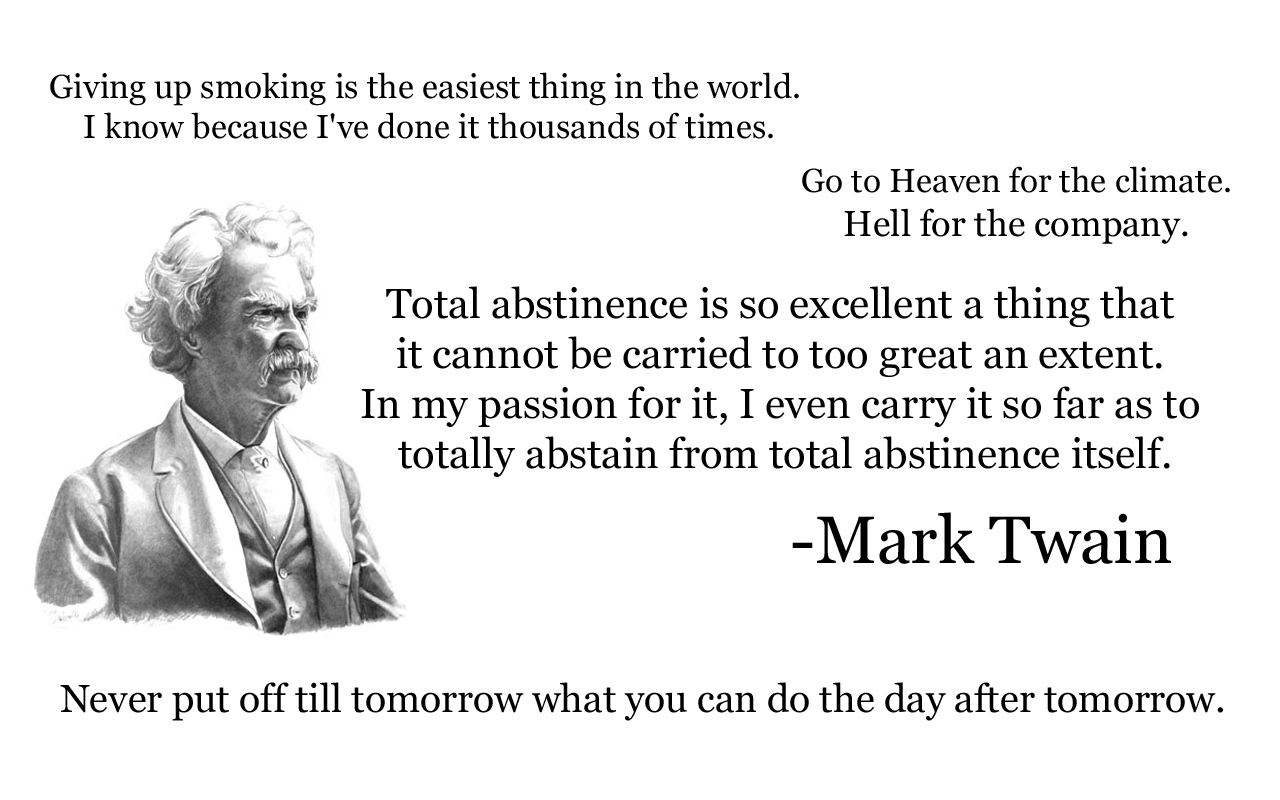
“Never put off till tomorrow what you can do the day after tomorrow.”

“It’s not the size of the dog in the fight, it’s the size of the fight in the dog.”

“When angry, count to four; when very angry, swear.”

“When your friends begin to flatter you on how young you look, it’s a sure sign you’re getting old.”

“‘Classic.’ A book which people praise and don’t read.”

“There is no sadder sight than a young pessimist.”

“The right word may be effective, but no word was ever as effective as a rightly timed pause.”

“Ideally a book would have no order to it, and the reader would have to discover his own.”

“Only kings, presidents, editors, and people with tapeworms have the right to use the editorial ‘we.'”

Japan’s technological edge

20130203-105253.jpg

Japan, today, has a demographic problem where over 22% of their population consists of senior citizens. In order to make the lives of senior citizens better and enable them to move around and do more work than they physically can, engineers in Japan have invented a robotic suite that can be worn around a person’s arms or legs and it allows the old and physically challenged to walk and use their limbs far better than they could otherwise.

Japan has come up with an innovative technological solution to a challenge faced by the country and this is one of the many things that truly make Japan one of the most efficient countries in the world.

And what have we been doing? We’ve been busy building statues, neglecting education, banning books and films, punishing cartoonists, curbing the Internet, and ridiculing ideas that most of the uneducated population does not understand. It’s like we have no real problems.

The Quotable Mark Twain

marktwainquotes

“Don’t go around saying the world owes you a living. The world owes you nothing. It was here first.”

“Age is an issue of mind over matter. If you don’t mind, it doesn’t matter.”

“Anger is an acid that can do more harm to the vessel in which it is stored than to anything on which it is poured.”

“The reports of my death have been greatly exaggerated.”

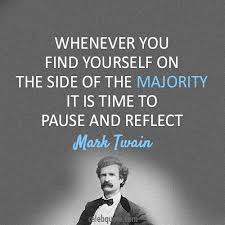
“Whenever you find yourself on the side of the majority, it is time to pause and reflect.”

“Courage is resistance to fear, mastery of fear, not absence of fear.”

“Good friends, good books and a sleepy conscience: this is the ideal life.”

“Giving up smoking is the easiest thing in the world. I know because I’ve done it thousands of times.”

“A man is never more truthful than when he acknowledges himself a liar.”

“Action speaks louder than words but not nearly as often.”

“A man’s character may be learned from the adjectives which he habitually uses in conversation.”

“Clothes make the man. Naked people have little or no influence on society.”

The Quotable Reader

reading2

A book is the only place in which you can examine a fragile thought without breaking it, or explore an explosive idea without fear it will go off in your face. It is one of the few havens remaining where a man’s mind can get both provocation and privacy. ~Edward P. Morgan

The man who does not read good books has no advantage over the man who can’t read them. ~Mark Twain, attributed

My test of a good novel is dreading to begin the last chapter. ~Thomas Helm

You know you’ve read a good book when you turn the last page and feel a little as if you have lost a friend. ~Paul Sweeney

It is what you read when you don’t have to that determines what you will be when you can’t help it. ~Oscar Wilde

Religious Intolerance?

tolerance

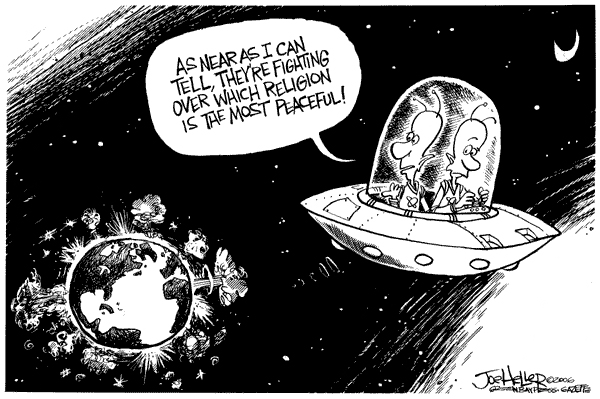
If you ask religious people why religion is good, the first thing they tell you is that religion teaches tolerance.

What a shame! The reality is quite opposite.

Religious people think that it is their birthright to be offended. If Salman Rushdie writes a novel, they get offended.  When MF Hussain makes paintings or some newspaper publishes cartoons, they get hurt. Kamal Haasan makes a movie in which a terrorist is reading a holy book and people get hurt without even watching it. Did any of those protesting people really read the book or try and understanding Hussain’s art or made sense of the cartoons or Haasan’s movie with tolerance? The answer is a resounding No. Then where does the hurt come from? Is it genuine or assumed?

To come back to the point of tolerance, I am convinced that religion does not teach any tolerance at all. At least, we do not see any real examples of tolerance being practiced by any religious groups. What it really teaches is to burn, ban, threaten, torture, and exterminate anything and anyone they do not like. If their feelings are really hurt by some book, they can simply choose to not read it. For instance, what is written in some portions of some scriptures really offends my intelligence and feeling of secularism, and some of the things the religious leaders say and do really bothers me a lot and I do not agree with most of what they say. Most of the movies make fun of non-believers and none of them touches the possibility of atheism being one more point of view. But I and other non-believers (or liberals as some might call us) do not get offended and threaten religious people in return. We do not burn scriptures or threaten godmen to be silent. We do not desecrate temples and mosques or call for the beheading of secularists who convert to some religion. We simply choose to ignore such texts and people and mind our own business.

We never force others away from following whatever books or people they want to. Why? Because we acknowledge that everybody has the choice. That is the most logical and tolerant view. But for the religious fraternity, even if someone else reads a book by someone they dislike, it offends them. How unbelievable! My reading a novel somehow magically hurts someone else? Incredible!

Tolerance means giving others the space and the right to say, read or write whatever they want to regardless of one’s own opinion on the matter. One doesn’t have to accept or even respect the beliefs of others in order to be tolerant. One just has to accept that everybody has rights and we should agree to disagree.

Upon being offended, the first thing believers do is threaten havoc and violent clashes if what they demand is not fulfilled. Is that tolerance or intolerance? I think the believer’s version of tolerance ultimately means this: We will do the nice thing of tolerating you and your freedom of expression only as long as you say what we approve of, but the moment you say something we do not like, we would be forced to get appallingly violent.

So, as long as someone is saying and doing what only the religious fraternity likes, where is the question of tolerance in that?